Wednesday, 6 January 2021

What's Your Why?

To All Business Leaders: My Thought for 2021

Happy New Year to all. Given that I started Newton Day to create ‘apple dropping moments’ for companies, I make it my mission every year in the holiday season to think about the big topics and drum up an article that brings pause for thought. Here’s my 2021 attempt. I do hope it provokes a thought or two!

Every business needs a purpose behind its brand to explain to its workforce, investors, customers, prospects and partners why it exists. Today, more than ever, buyers are influenced by the ‘WHY’ of your business — and how your business contributes to society. How motivational is the WHY of YOUR BUSINESS?

The day when WHY became a game-changer for brands

It’s difficult to narrow down precisely the point in time when the WHY of a brand became all consuming. There are some notable diary dates.

Simon Sinek

Back in 2009, Simon Sinek gained notoriety for his powerful and inspiring arguments (framed in his book ‘Start with Why’) around the need to inspire people by having a clear picture of why a brand exists. As Sinek puts it, “People don’t buy what you do. They buy why you do it.”

Steve Jobs speaking about Apple’s purpose

Earlier still, in 1997, it was the marketing visionary Steve Jobs — best known for being the thought leader of Apple — who took his learnings from working in the advertising industry and brought the Apple brand back on track by focusing the brand on how it empowers its customers to make a contribution to change the world for the better rather than product specs. It also spawned, one of the most awesome lines ever uttered when Jobs said, “The one thing you know (about visionaries like Einstein, Gandhi, Amelia Earhart, and Martin Luther King Jr.) is that if they ever used a computer, it would’ve been a Mac.”
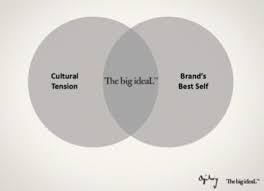
Ogilvy’s ‘The Big IdeaL’

I think the actual moment in history when the world of brands realized its axis had shifted towards ‘the power of WHY’ happened at the turn of the century and was exposed in a 2010 session given by Ed Bell, Ogilvy’s Shanghai Group Planning Director, and Paul Heath, its Asia-Pacific CEO who were looking into what Ogilvy called ‘The Big IdeaL.’ They argued that, while the 1970;’s was a ‘commodity economy’, the 1980’s was a ‘goods economy’ (where the key was about cost), and the 1990’s became a ‘service economy’, the 21st century has become the ‘experience economy.’ Now, authenticity can make or break a brand, and consumers will expose ‘half-truths’. As Health put it, “Consumers today want something to believe in.”

Is yours a PURPOSEFUL Brand? And what can you do if it isn’t?

We all know the characteristics that go to make-up a purposeful brand. We only need think of those great companies that harness youthful energy to solve a community problem, recycle an asset that wasn’t being well used, offer their profits up instead of pocketing the rewards, work to harness clean energy, or re-build parts of a failing economy. These are brands we ‘get’ when it comes to the WHY.

Other brands with purpose, are not so squeaky clean on the inside — i.e., those underpinned by ‘big greedy corporations’ that feed their profits to already rich investors — but on the outside, their brand still projects something positive.

Think about brands like Virgin, who profit from the association with its founder Sir Richard Branson , and that fact that he’s such a nice and awesome guy. And Disney, who are still seen as the best friend of every child who can still dream of pixies and fairy godmothers. And what about Google, who are still seen by many to be a champion of the little guy? Then, there’s Apple that, regardless of its brand story and rebel values, continues to churn profits around the world by leveraging offshore low-cost manufacturing to feed eye-popping profits to its U.S. entered shareholders.

The fact is, not every business can gain the investment it needs without the sponsorship of others with capital. They might not have a choice but to become in some people’s eyes a ‘greedy corporation’ in order to bring their idea into light. And not every business can do the core deliverable of what it does to bring value to customers for the sake of charity, to solve world issues, or bring value to local communities.

Having said that, I’d also argue that doesn’t mean businesses shouldn’t consider how they create job opportunities for people in need of work, or share profits with its extended workforce, adopt policies to protect the planet, or donate some of its profits, resources, or time to charitable causes.

If you build software, cut cloth, or clean houses, it’s not easy to round out the purpose of your brand, especially if the company was founded on the practical need to create personal wealth.

Remember, the WHY, the PURPOSE; it’s all about AUTHENTICITY.

Being something you’re not, even if it looks impressive on a website, only serves to corrupt your brand authenticity. These half truths will get found out.

My recommendation is for companies to be the best form of why they do what they do.

Think about what led you (or the founders) to create the company. If you are a staffing company, perhaps you started the business because you wanted to find opportunities for people to build careers. Consider offering courses, mentoring, or coaching programs alongside your core business activities to get back to the motivations that led to your company formation. If you genuinely do clean houses for a living, consider the wider value you bring; the emotional support you offer people living in isolation in need of a conversation, or those occasions when you’ve been there to pick up parcels when people need a helping hand.

The WHY of your brand should always articulate the motivation that brings the passion that drives what your business spends its time doing.

Selling your business idea short, because you’re selling yourself short

Successful brands of the future will need to exist because they’re doing more than just earn money to shareholders, even if that’s you.

When I started Encanvas with Andrew and Nick Lawrie back in the early 2000’s, we had a vision that there are thousands of people in the world with business ideas, unable to translate their ideas into businesses because they didn’t know how to code, or build apps to translate their idea into outcomes. We wanted to solve that conundrum by creating a way to build enterprise-grade apps without code BETTER than you could with manual coding. We weren’t particularly thinking about the money this would generate. We just wanted to see if we could make those ambitions happen for entrepreneurs and departmental managers who just wanted to turn their ideas into software apps. Today, Encanvas is one of the leading No-Code solutions in a £5 billion global market. It’s been used by large and small companies around the world, Governments, Educators, Consultants and Retailers. We were fortunate, we started with WHY and found something we really wanted to do that we could turn into a business.

If your brand is ‘all about the money’ then maybe it’s time for some quiet reflection. Perhaps it’s time to revisit YOUR WHY. It’s probable that you will be much happier doing something that returns profound emotional and spiritual value back to you and your colleagues rather than a soulless pay check.

I leave the last word to Steve Jobs.

“Have the courage to follow your heart and intuition. They somehow already know what you truly want to become. Everything else is secondary.”
STEVE JOBS


Thursday, 10 December 2020

FUSION Versus DevOps—Why the World of Digital Transformation Will Change in 2021

According to the latest thinking by Gartner, DevOps teams are about to get displaced in the enterprise by FUSION teams.

Many firms pursuing distributed delivery are using “fusion teams” to bring together IT and business employees to develop digital solutions. As fusion teams become more prevalent, enterprise architecture and technology innovation leaders must actively support these blended, multidisciplinary teams.—Gartner Enterprise Architecture Research Team, Feb 2020.

The term Development Operations (DevOps) has been on the lips of Digital Officers and CIOs for the past three years.  This team of SCRUM crazy tech wizards has been charged with driving digital transformation project forward in double quick time. But, according to Gartner, that world is about to change—and 2021 is likely to be the year it happens.


The Enterprise Innovation Factory

Customers are ever more online, remote, discerning, and seeking personalised experiences.  Moreover, they want to be in control of their purchasing experiences, call the shots, not be kept waiting, and they want answers when they seek them.  

Technologies like Machine-Learning and Artificial Intelligence, sensor networks (the ‘Internet of Things’), blockchain, AI-driven conversational chatbots, virtual and hybrid reality, and 3D modelling are transforming customer value and experiences.  

Every business needs to harness the potential of digital technologies to surprise and delight their customers, and stay competitive.  That requires tech teams who can be the ‘tip of the spear’ and lead the charge.  Someone somewhere needs to understand the hyper automation journey and what the outcome looks like from a tech-stack perspective.

The rapid pace of change in technologies and tools has left many traditional IT teams disorientated and confused about their role (i.e, ‘Do you want me to focus on upgrading our apps, displacing legacy systems and keeping the lights on or not?).

The solution for many organization has become what’s known as two-speed IT.  Put another way, it’s about parachuting a new team of tech experts to create a Development Operations team that is equipped with the right skills blend and tech tools to implement agile developments.  That was good 3-years ago, but today—IT’S STILL TOO SLOW.


The Challenges of Coding

The pace of digital evolution is now SO SWIFT that there’s not enough time to code the majority of apps anymore.  A growing demand for short-cuts and code block re-use has popularized the use of Low-Code tools that make coding faster.   These solutions, while useful, haven’t done anything to remove one of the fundamental challenges of application ideation: That is the barrier that exists between IT and the business when you use code and script. 


Enter No-Code

At one time, any applications design and deployment technology that didn’t show the appropriate amount of love for the art of coding would be shunned by businesses as being ‘amateur stuff’ that wasn’t ‘enterprise-grade.’  Practitioners in the art of coding would argue that any tech platform not focused on the needs of the coder was deemed unable to cater for the vast array of requirements modern enterprise apps dictate.  They even had a name for these enthusiastic amateurs—‘Citizen developers.’

That isn’t true anymore.  In the past decade, cloud-based technologies have transformed the potential of Platform-as-a-Service ecosystems to support the design, deployment and operation of applications—all achieved without coding.

Platforms like OutSystems, Encanvas, Mendix, BettyBlocks, Outgrow, AppSheet and Bubble are able to offer enterprise-grade results.  Some, offer integrated data crunching and interoperability tools together with the ability to ‘code if you want to’ or add existing DLLs, HTML, Javascript or C#.


Fusion Teams—Bringing ‘IT’ and ‘the Business’ Together

These new tools enable Business Analysts to scope and design solutions, removing the ‘deep technical’ duties from the task of authoring an application.  That means business people and tech people can build apps in real-time in workshops without having to create a SCRUM or run off into back-rooms to code. 

While the technology is transformative, it’s taken some time for organizational designs and cultures to adjust to this new reality.  FUSION TEAMS are the emerging solution to that challenge.

'Multidisciplinary digital business teams — or “fusion teams” — are critical to success in digital transformation. Progressive CIOs foster rather than fight the rise of the distributed digital delivery model and maximize value by focusing on the human aspects of managing digital business risk.’—https://www.gartner.com/en/documents/3955908/fusion-teams-a-new-model-for-digital-delivery ‘Fusion Teams: A New Model for Digital Delivery, 2020.’


How Does a Fusion Team Work?

A Fusion Team is a cross-functional project team brought together around a particular app development initiative.  It is generally a temporary organizational structure that ‘fuses together’ technical, commercial, change management, data security and legal considerations in the form of a transitional project team.

The purpose of a Fusion Team is to come together, implement the change, then go on to do other things.  This means its not always necessary that the entire team has to be employed on full-time employment contracts, forging the possibility for Statement-of-Work styled project programs to be established whenever business needs are identified.

While project teams that use No-Code tooling to deliver app development outcomes isn’t particularly new, the fact that Gartner has ‘given this team a name’ and is now priming the enterprise IT market to consider a new way of working.

'Digital opportunities and risks are cross-cutting and fast changing, so it’s no surprise that most IT employees participate in flexible “fusion” teams that extend across IT and other parts of the business.’—Gartner CIO Research Team, Fusion Teams: Cross-Functional Collaboration for the Digital Era, June 2017.

Summary

In one of its latest papers, Gartner argues, ’The rise of fusion teams, or multidisciplinary digital business teams, requires CIOs to rethink the role of IT in supporting enterprise strategy.’  We would agree.  The adoption of Fusion Teams into the enterprise biosphere is going to take a significant shift in attitudes and the final acceptance that coding is always going to be required for exceptional cases, but for the majority of applications building blocks, No-Code tools work just fine. It may take all of 2021, and a little time longer than that, for some ‘head in the sand’ CIOs to take on that little fact.


Friday, 8 March 2019

Is it time to throw out technology and revert to pen and paper to re-discover your productivity?

In this article I’m going to discuss two newish forms of journaling method — bullet journaling and interstitial journaling—that might just change your life but, before I do, a bit of a back story! 

Im as guilty as anyone for rolling out of bed in the morning to grab my smartphone before reaching my toothbrush, and I’m a self-confessed tech geek with all of the toys of modern day digital living. I also have an interest in software companies and start-ups that are technology through and through. So you might be a little surprised to hear this weekend I bought a complete pack of new A6 dotted notepads. Crazy right?
Maybe, maybe not.

If, like me, you live a hectic multi-tasking life, and there’s never enough time in the day, then (again, like me) you’ve probably revisited the challenge of managing your time. You may have tried out a few alternatives to see what works best for you.
My role has brought me extremely close to the subject of office productivity. So when ‘new approaches’ or ‘new tools’ emerge through social business channels, I will always force myself to consider them. 

Like many of my generation, I started life with a trusty Filofax. Then, in the spirit of geek-ism, I moved on to standard office calendaring and task list apps. When social messaging apps like Google Wave and Yammer emerged, I tried them too. And in recent years, I’ve moved on to tools like Google Keep, Microsoft OneNote, Evernote and Trello.

My progress so far? To be honest, I wouldn’t say any of the tech solutions have worked for me personally. I find myself losing time switching even more between apps and my time being stolen to keyboard data entry. While these new tech tools haven’t been good for me, they have been good for my colleagues! At least now we can share diaries and tasks.. And they know normally where I am and what I’m doing.

But that perfect approach to managing my day has still evaded me and I always have that frustration of not knowing what I did two weeks, maybe even three days ago — other than what my calendar tells me.

I was therefore intrigued when I ran across two articles in quick succession talking about the rewards of low-tech ‘pen and paper’ approaches to the age-old issue of managing your own time.

And just a brief step-back on why it matters…

There is a great video of Bill Gates and Warren Buffet running around the wibbly-wobbly-web where Bill explains how surprised he was to find WB keeps all of his meetings in a pocket diary… And how few of them he booked! I imagine, in contrast, Bill was looking at an Office365 calendar, full to the brim, scratching his head! The fact is that YOUR Time is the most precious resource you have when you’re running a business. You need to treat it as the scarce resource it is. When researchers look into the common attributes of successful entrepreneurs, pretty much the only thing they can agree on is they possess remarkable focus and prioritize their time extremely well. And that’s why I found myself in a Stationers at the weekend, purchasing some notepads.
The two systems I’m trying are both approaches that contribute to managing your time in an efficient way by keeping track of what you have to do, what you’re doing, and what you’ve done. Given the focus of the activity is to manage a journal of how you plan your time, are spending your time.. and have spent your time, these methods commit as much time on recording history as they do planning your future.

Bullet journaling is the first method I came across. As the term suggests, it’s about maintaining very brief notation around your activities. The developers of this method have come up with a simple visual way of managing tasks, events, and notes.

Interstitial journaling is the other method I’ve encountered. It’s an approach that recognizes that humans are not good at multi-tasking and the best way to manage multi-tasking is to manage the transition from one task to the next by writing a simple statement of what you’ve just done, and what you plan to do next. The argument is that it helps to declutter your mind of one task before you jump into the next.

Do these systems work? Well, for me It’s early days but so far the experiment seems to be going quite well. I definitely find myself spending less time switching between tasks, and I do ‘feel’ more organized-but, with my terrible writing, well just have to see how long it lasts! 
Here are links to articles on both subjects:


Have you encountered these new methods? If so, I’d love to know how you’re getting on, and whether it’s changed your time management performance.

Ian

Tuesday, 5 March 2019

19 Years of being an Entrepreneur... What have a learned?

I started my first sole trader company, Newleaf-Dialogue in 2000 having left corporate life. That’s me on the left at the tender age of thirty-ish. Here I am in 2019 (on the right) looking somewhat older. I look back at that picture of a fresh-faced young businessman and wonder how anyone ever entrusted me with their projects!
I’ve had a few successes, some near misses, a few bits of bad advice, some good — and a few disappointments along the way. I’ve also made lots of lifelong friends. Sure, I’ve also been able to earn a pretty decent crust and my kids have grown up along the way — but what have I learned?
There are a lot of bits I’ve picked up I could include in that list; knowing where you’re headed, staying focused on winning customers, not getting distracted by the minutiae of business administration, never loosening your grip on the purse-strings, forgive yourself the mistakes and learning lessons, always enjoy it… but I’ve settled on three takeaways that really have been painfully learned.
I guess my first takeaway from those nineteen years is around what I’ve learned about myself along the way. There have been a few times when ‘I thought I was ready’ to jump up another gear in what I was doing, only to realize — maybe a decade later — that I wasn’t ready. When you’re an entrepreneur, you’re always learning.
The fact of the matter is, you’re never ready to run a business.
There are always new things to learn. Every twist and turn of a business, just like parenting, is about learning on the job. Having the humility to know that you’re not the ‘finished package’ blended with the self-confidence to believe you’re capable of stepping up to the challenge is the vital recipe for survival.
My second takeaway is along the lines of getting the balance right of trusting your own judgment and relying on others. On this score, I don’t think I’ve always got it right and I’m still learning. Sometimes, you have to call on others to balance the skills mix you need to run a business. Other times though, you have to trust your instincts and lead your business. It’s YOUR business after-all!
My third and ultimate takeaway sounds so embarrassingly simple that you’d think it obvious. Never forget why you do it. Entrepreneurs are the wealth creators of the world. They’re the people that give others the inspiration to try something themselves. They’re the spark that set passions alight in others to discover their own gifts. They’re the people that lead great teams and give everyone a buzz and desire to be a part of something. And they’re the people that deliver. I wake up every morning with oodles of activation energy and bounce around the office because I love what I do, and after nineteen years doing it, I can’t remember what it felt like not to be thinking about my next business project with a grin.
Has that experience made me a better businessman; a better supplier to serve my customers? Were you to judge any response to that answer as a customer, I suspect the answer is no. Why not? Because I’ve always committed 120% to make sure I deliver on my promises to customers and ensure they get what they paid for.
Whether it’s your first day on the job or last morning before retirement, I’d say every entrepreneur must do that well.
Ian Tomlin is CEO of the conversational marketing company, Newton Day.

Monday, 19 March 2018

Do you think enough about how you think?


(Thought for the day... And possibly week)
 
Do you think enough about how you think?  I know that sounds slightly ridiculous but it's quite important. 
 
There's a lot going around the blogosphere about how and why humans need to rediscover being human.  This is because, as a race, we've now created our own competition in the form of artificial intelligence (clever humans).  Listen to experts like the recently passed Stephen Hawkins and the real-world manifestation of Ironman that is Elon Musk and you would be encouraged to believe we've finally invented something that can erase us from the planet.  Perhaps, perhaps not, but robots and AI definitely have the potential to break the economic rule that says growth in the productivity of economies leads to increased wages and therefore more spending power to drive consumer spending.
 
The other thing we know robots can definitely do better than humans are repeatable, tedious tasks; you know, like the hundred  or so ones that people do in the office, like populating forms, crunching data in spreadsheets, producing legal papers and writing articles like this one.  Funny thing is, you don't actually know whether it was me who wrote this article or whether I had Encanvas produce it.
 
And while all of this automation and computing is going on, Otto Sharmer and 'guru's like him are tearing up the conferencing circuit waking executives up to  the fact that they don't habitually take in those sparkly fresh ideas with an open mind.... Nope.  Most of us are way too quick to 'download' new thinking only to put it into a familiar box. Sharmer argues that those businesses in need of transformation require someone at the helm that does something more than just drop new ideas into old boxes.  Afterall, the boys and girls in the fresh fruit markets can sort oranges and apples into the most appropriate box!  You're not exactly leadership material nowadays if that's all you know. 
 
As a consultant I'm often speaking to clients about single loop and double loop learning - what the remarkable knowledge management 'guru' Dr. Martin Vasey described as the difference between 'doing things better' and doing better things'.  With double-loop learning you really do need humans that bounce ideas around the room (or stick them to walls with PostIt Notes) and are prepared to look beyond how processes work.  There was a time for LEAN - when most manufacturing firms really were shoody at repeatedly making products of a high quality.  It's now past.  If you can't make a decent produce at a market ready price, you're either dead or dying.  That's not a watering hole you want to stick around for too long!  Yep, douple-loop learning is where it's at, and to do that you need people that think differently. 
 
Naturally, when for decades society has tried really hard to drive the creative types and people with Asbergers (who really do think differently) to the very back of the class, pasting stickers on the back of their shirts like "Here sits an idiot that doesn't follow rules", suddenly these weird - rare kids- have become the nerdy saviour of man-kind.  And it's not because they've suddenly learnt how to think linial.  No, it's because he or she is a creative thinker that's always comfortable to take risks, question the norms, strive for perfection, because they've never fitted in and so it doesn't feel any different.
 
So how do you think?
 
There's actually a name for it... you know, the act of thinking about thinking.  It's called metacognition (yup, you can genuinely learn something new everyday).
 
'Course, Albert Einstein has been misquoted about a million times for saying something like, 'We can not solve our problems with the same thinking we used when we created them.'  And he's right.
It's a really useful skill to be able to apply different kinds of thinking, new patterns and shapes to the way we absorb information and rationalise it.  Bear in mind, I'm not saying I can do it.
 
I describe myself as a curvy thinker.  I know a lot of straight line thinkers (and boy gosh, they're useful when you need to map a process or step through a problem one step at a time!).  but they're less useful when you need off-the-wall thoughts (nice lyric, Michael Jackson).  Most people are too constrained by their environment and their education to do anything else but linial thinking.  Businesses need all sorts of thinkers - but in a world of transformation and AI robots, it's the creative thinking of humans that sets us apart.  Robots are GREAT linial thinkers. 
 
Having the ability to adapt how we think, to NOT think in a linial way, could be the main reason why humans retain a role in the workplace.
 
So grab your mouse and click on metacognition and see where it takes you. A new idea perhaps?
 
Ian