Wednesday, 6 January 2021

What's Your Why?

To All Business Leaders: My Thought for 2021

Happy New Year to all. Given that I started Newton Day to create ‘apple dropping moments’ for companies, I make it my mission every year in the holiday season to think about the big topics and drum up an article that brings pause for thought. Here’s my 2021 attempt. I do hope it provokes a thought or two!

Every business needs a purpose behind its brand to explain to its workforce, investors, customers, prospects and partners why it exists. Today, more than ever, buyers are influenced by the ‘WHY’ of your business — and how your business contributes to society. How motivational is the WHY of YOUR BUSINESS?

The day when WHY became a game-changer for brands

It’s difficult to narrow down precisely the point in time when the WHY of a brand became all consuming. There are some notable diary dates.

Simon Sinek

Back in 2009, Simon Sinek gained notoriety for his powerful and inspiring arguments (framed in his book ‘Start with Why’) around the need to inspire people by having a clear picture of why a brand exists. As Sinek puts it, “People don’t buy what you do. They buy why you do it.”

Steve Jobs speaking about Apple’s purpose

Earlier still, in 1997, it was the marketing visionary Steve Jobs — best known for being the thought leader of Apple — who took his learnings from working in the advertising industry and brought the Apple brand back on track by focusing the brand on how it empowers its customers to make a contribution to change the world for the better rather than product specs. It also spawned, one of the most awesome lines ever uttered when Jobs said, “The one thing you know (about visionaries like Einstein, Gandhi, Amelia Earhart, and Martin Luther King Jr.) is that if they ever used a computer, it would’ve been a Mac.”
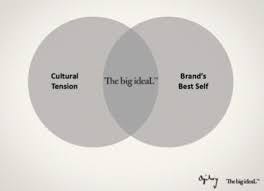
Ogilvy’s ‘The Big IdeaL’

I think the actual moment in history when the world of brands realized its axis had shifted towards ‘the power of WHY’ happened at the turn of the century and was exposed in a 2010 session given by Ed Bell, Ogilvy’s Shanghai Group Planning Director, and Paul Heath, its Asia-Pacific CEO who were looking into what Ogilvy called ‘The Big IdeaL.’ They argued that, while the 1970;’s was a ‘commodity economy’, the 1980’s was a ‘goods economy’ (where the key was about cost), and the 1990’s became a ‘service economy’, the 21st century has become the ‘experience economy.’ Now, authenticity can make or break a brand, and consumers will expose ‘half-truths’. As Health put it, “Consumers today want something to believe in.”

Is yours a PURPOSEFUL Brand? And what can you do if it isn’t?

We all know the characteristics that go to make-up a purposeful brand. We only need think of those great companies that harness youthful energy to solve a community problem, recycle an asset that wasn’t being well used, offer their profits up instead of pocketing the rewards, work to harness clean energy, or re-build parts of a failing economy. These are brands we ‘get’ when it comes to the WHY.

Other brands with purpose, are not so squeaky clean on the inside — i.e., those underpinned by ‘big greedy corporations’ that feed their profits to already rich investors — but on the outside, their brand still projects something positive.

Think about brands like Virgin, who profit from the association with its founder Sir Richard Branson , and that fact that he’s such a nice and awesome guy. And Disney, who are still seen as the best friend of every child who can still dream of pixies and fairy godmothers. And what about Google, who are still seen by many to be a champion of the little guy? Then, there’s Apple that, regardless of its brand story and rebel values, continues to churn profits around the world by leveraging offshore low-cost manufacturing to feed eye-popping profits to its U.S. entered shareholders.

The fact is, not every business can gain the investment it needs without the sponsorship of others with capital. They might not have a choice but to become in some people’s eyes a ‘greedy corporation’ in order to bring their idea into light. And not every business can do the core deliverable of what it does to bring value to customers for the sake of charity, to solve world issues, or bring value to local communities.

Having said that, I’d also argue that doesn’t mean businesses shouldn’t consider how they create job opportunities for people in need of work, or share profits with its extended workforce, adopt policies to protect the planet, or donate some of its profits, resources, or time to charitable causes.

If you build software, cut cloth, or clean houses, it’s not easy to round out the purpose of your brand, especially if the company was founded on the practical need to create personal wealth.

Remember, the WHY, the PURPOSE; it’s all about AUTHENTICITY.

Being something you’re not, even if it looks impressive on a website, only serves to corrupt your brand authenticity. These half truths will get found out.

My recommendation is for companies to be the best form of why they do what they do.

Think about what led you (or the founders) to create the company. If you are a staffing company, perhaps you started the business because you wanted to find opportunities for people to build careers. Consider offering courses, mentoring, or coaching programs alongside your core business activities to get back to the motivations that led to your company formation. If you genuinely do clean houses for a living, consider the wider value you bring; the emotional support you offer people living in isolation in need of a conversation, or those occasions when you’ve been there to pick up parcels when people need a helping hand.

The WHY of your brand should always articulate the motivation that brings the passion that drives what your business spends its time doing.

Selling your business idea short, because you’re selling yourself short

Successful brands of the future will need to exist because they’re doing more than just earn money to shareholders, even if that’s you.

When I started Encanvas with Andrew and Nick Lawrie back in the early 2000’s, we had a vision that there are thousands of people in the world with business ideas, unable to translate their ideas into businesses because they didn’t know how to code, or build apps to translate their idea into outcomes. We wanted to solve that conundrum by creating a way to build enterprise-grade apps without code BETTER than you could with manual coding. We weren’t particularly thinking about the money this would generate. We just wanted to see if we could make those ambitions happen for entrepreneurs and departmental managers who just wanted to turn their ideas into software apps. Today, Encanvas is one of the leading No-Code solutions in a £5 billion global market. It’s been used by large and small companies around the world, Governments, Educators, Consultants and Retailers. We were fortunate, we started with WHY and found something we really wanted to do that we could turn into a business.

If your brand is ‘all about the money’ then maybe it’s time for some quiet reflection. Perhaps it’s time to revisit YOUR WHY. It’s probable that you will be much happier doing something that returns profound emotional and spiritual value back to you and your colleagues rather than a soulless pay check.

I leave the last word to Steve Jobs.

“Have the courage to follow your heart and intuition. They somehow already know what you truly want to become. Everything else is secondary.”
STEVE JOBS


Thursday, 10 December 2020

FUSION Versus DevOps—Why the World of Digital Transformation Will Change in 2021

According to the latest thinking by Gartner, DevOps teams are about to get displaced in the enterprise by FUSION teams.

Many firms pursuing distributed delivery are using “fusion teams” to bring together IT and business employees to develop digital solutions. As fusion teams become more prevalent, enterprise architecture and technology innovation leaders must actively support these blended, multidisciplinary teams.—Gartner Enterprise Architecture Research Team, Feb 2020.

The term Development Operations (DevOps) has been on the lips of Digital Officers and CIOs for the past three years.  This team of SCRUM crazy tech wizards has been charged with driving digital transformation project forward in double quick time. But, according to Gartner, that world is about to change—and 2021 is likely to be the year it happens.


The Enterprise Innovation Factory

Customers are ever more online, remote, discerning, and seeking personalised experiences.  Moreover, they want to be in control of their purchasing experiences, call the shots, not be kept waiting, and they want answers when they seek them.  

Technologies like Machine-Learning and Artificial Intelligence, sensor networks (the ‘Internet of Things’), blockchain, AI-driven conversational chatbots, virtual and hybrid reality, and 3D modelling are transforming customer value and experiences.  

Every business needs to harness the potential of digital technologies to surprise and delight their customers, and stay competitive.  That requires tech teams who can be the ‘tip of the spear’ and lead the charge.  Someone somewhere needs to understand the hyper automation journey and what the outcome looks like from a tech-stack perspective.

The rapid pace of change in technologies and tools has left many traditional IT teams disorientated and confused about their role (i.e, ‘Do you want me to focus on upgrading our apps, displacing legacy systems and keeping the lights on or not?).

The solution for many organization has become what’s known as two-speed IT.  Put another way, it’s about parachuting a new team of tech experts to create a Development Operations team that is equipped with the right skills blend and tech tools to implement agile developments.  That was good 3-years ago, but today—IT’S STILL TOO SLOW.


The Challenges of Coding

The pace of digital evolution is now SO SWIFT that there’s not enough time to code the majority of apps anymore.  A growing demand for short-cuts and code block re-use has popularized the use of Low-Code tools that make coding faster.   These solutions, while useful, haven’t done anything to remove one of the fundamental challenges of application ideation: That is the barrier that exists between IT and the business when you use code and script. 


Enter No-Code

At one time, any applications design and deployment technology that didn’t show the appropriate amount of love for the art of coding would be shunned by businesses as being ‘amateur stuff’ that wasn’t ‘enterprise-grade.’  Practitioners in the art of coding would argue that any tech platform not focused on the needs of the coder was deemed unable to cater for the vast array of requirements modern enterprise apps dictate.  They even had a name for these enthusiastic amateurs—‘Citizen developers.’

That isn’t true anymore.  In the past decade, cloud-based technologies have transformed the potential of Platform-as-a-Service ecosystems to support the design, deployment and operation of applications—all achieved without coding.

Platforms like OutSystems, Encanvas, Mendix, BettyBlocks, Outgrow, AppSheet and Bubble are able to offer enterprise-grade results.  Some, offer integrated data crunching and interoperability tools together with the ability to ‘code if you want to’ or add existing DLLs, HTML, Javascript or C#.


Fusion Teams—Bringing ‘IT’ and ‘the Business’ Together

These new tools enable Business Analysts to scope and design solutions, removing the ‘deep technical’ duties from the task of authoring an application.  That means business people and tech people can build apps in real-time in workshops without having to create a SCRUM or run off into back-rooms to code. 

While the technology is transformative, it’s taken some time for organizational designs and cultures to adjust to this new reality.  FUSION TEAMS are the emerging solution to that challenge.

'Multidisciplinary digital business teams — or “fusion teams” — are critical to success in digital transformation. Progressive CIOs foster rather than fight the rise of the distributed digital delivery model and maximize value by focusing on the human aspects of managing digital business risk.’—https://www.gartner.com/en/documents/3955908/fusion-teams-a-new-model-for-digital-delivery ‘Fusion Teams: A New Model for Digital Delivery, 2020.’


How Does a Fusion Team Work?

A Fusion Team is a cross-functional project team brought together around a particular app development initiative.  It is generally a temporary organizational structure that ‘fuses together’ technical, commercial, change management, data security and legal considerations in the form of a transitional project team.

The purpose of a Fusion Team is to come together, implement the change, then go on to do other things.  This means its not always necessary that the entire team has to be employed on full-time employment contracts, forging the possibility for Statement-of-Work styled project programs to be established whenever business needs are identified.

While project teams that use No-Code tooling to deliver app development outcomes isn’t particularly new, the fact that Gartner has ‘given this team a name’ and is now priming the enterprise IT market to consider a new way of working.

'Digital opportunities and risks are cross-cutting and fast changing, so it’s no surprise that most IT employees participate in flexible “fusion” teams that extend across IT and other parts of the business.’—Gartner CIO Research Team, Fusion Teams: Cross-Functional Collaboration for the Digital Era, June 2017.

Summary

In one of its latest papers, Gartner argues, ’The rise of fusion teams, or multidisciplinary digital business teams, requires CIOs to rethink the role of IT in supporting enterprise strategy.’  We would agree.  The adoption of Fusion Teams into the enterprise biosphere is going to take a significant shift in attitudes and the final acceptance that coding is always going to be required for exceptional cases, but for the majority of applications building blocks, No-Code tools work just fine. It may take all of 2021, and a little time longer than that, for some ‘head in the sand’ CIOs to take on that little fact.


Friday, 8 March 2019

Is it time to throw out technology and revert to pen and paper to re-discover your productivity?

In this article I’m going to discuss two newish forms of journaling method — bullet journaling and interstitial journaling—that might just change your life but, before I do, a bit of a back story! 

I’m as guilty as anyone for rolling out of bed in the morning to grab my smartphone before reaching my toothbrush, and I’m a self-confessed tech geek with all of the toys of modern day digital living. I also have an interest in software companies and start-ups that are technology through and through. So you might be a little surprised to hear this weekend I bought a complete pack of new A6 dotted notepads. Crazy right?
Maybe, maybe not.

If, like me, you live a hectic multi-tasking life, and there’s never enough time in the day, then (again, like me) you’ve probably revisited the challenge of managing your time. You may have tried out a few alternatives to see what works best for you.
My role has brought me extremely close to the subject of office productivity. So when ‘new approaches’ or ‘new tools’ emerge through social business channels, I will always force myself to consider them. 

Like many of my generation, I started life with a trusty Filofax. Then, in the spirit of geek-ism, I moved on to standard office calendaring and task list apps. When social messaging apps like Google Wave and Yammer emerged, I tried them too. And in recent years, I’ve moved on to tools like Google Keep, Microsoft OneNote, Evernote and Trello.

My progress so far? To be honest, I wouldn’t say any of the tech solutions have worked for me personally. I find myself losing time switching even more between apps and my time being stolen to keyboard data entry. While these new tech tools haven’t been good for me, they have been good for my colleagues! At least now we can share diaries and tasks.. And they know normally where I am and what I’m doing.

But that perfect approach to managing my day has still evaded me and I always have that frustration of not knowing what I did two weeks, maybe even three days ago — other than what my calendar tells me.

I was therefore intrigued when I ran across two articles in quick succession talking about the rewards of low-tech ‘pen and paper’ approaches to the age-old issue of managing your own time.

And just a brief step-back on why it matters…

There is a great video of Bill Gates and Warren Buffet running around the wibbly-wobbly-web where Bill explains how surprised he was to find WB keeps all of his meetings in a pocket diary… And how few of them he booked! I imagine, in contrast, Bill was looking at an Office365 calendar, full to the brim, scratching his head! The fact is that YOUR Time is the most precious resource you have when you’re running a business. You need to treat it as the scarce resource it is. When researchers look into the common attributes of successful entrepreneurs, pretty much the only thing they can agree on is they possess remarkable focus and prioritize their time extremely well. And that’s why I found myself in a Stationers at the weekend, purchasing some notepads.
The two systems I’m trying are both approaches that contribute to managing your time in an efficient way by keeping track of what you have to do, what you’re doing, and what you’ve done. Given the focus of the activity is to manage a journal of how you plan your time, are spending your time.. and have spent your time, these methods commit as much time on recording history as they do planning your future.

Bullet journaling is the first method I came across. As the term suggests, it’s about maintaining very brief notation around your activities. The developers of this method have come up with a simple visual way of managing tasks, events, and notes.

Interstitial journaling is the other method I’ve encountered. It’s an approach that recognizes that humans are not good at multi-tasking and the best way to manage multi-tasking is to manage the transition from one task to the next by writing a simple statement of what you’ve just done, and what you plan to do next. The argument is that it helps to declutter your mind of one task before you jump into the next.

Do these systems work? Well, for me It’s early days but so far the experiment seems to be going quite well. I definitely find myself spending less time switching between tasks, and I do ‘feel’ more organized-but, with my terrible writing, well just have to see how long it lasts! 
Here are links to articles on both subjects:


Have you encountered these new methods? If so, I’d love to know how you’re getting on, and whether it’s changed your time management performance.

Ian

Tuesday, 5 March 2019

19 Years of being an Entrepreneur... What have a learned?

I started my first sole trader company, Newleaf-Dialogue in 2000 having left corporate life. That’s me on the left at the tender age of thirty-ish. Here I am in 2019 (on the right) looking somewhat older. I look back at that picture of a fresh-faced young businessman and wonder how anyone ever entrusted me with their projects!
I’ve had a few successes, some near misses, a few bits of bad advice, some good — and a few disappointments along the way. I’ve also made lots of lifelong friends. Sure, I’ve also been able to earn a pretty decent crust and my kids have grown up along the way — but what have I learned?
There are a lot of bits I’ve picked up I could include in that list; knowing where you’re headed, staying focused on winning customers, not getting distracted by the minutiae of business administration, never loosening your grip on the purse-strings, forgive yourself the mistakes and learning lessons, always enjoy it… but I’ve settled on three takeaways that really have been painfully learned.
I guess my first takeaway from those nineteen years is around what I’ve learned about myself along the way. There have been a few times when ‘I thought I was ready’ to jump up another gear in what I was doing, only to realize — maybe a decade later — that I wasn’t ready. When you’re an entrepreneur, you’re always learning.
The fact of the matter is, you’re never ready to run a business.
There are always new things to learn. Every twist and turn of a business, just like parenting, is about learning on the job. Having the humility to know that you’re not the ‘finished package’ blended with the self-confidence to believe you’re capable of stepping up to the challenge is the vital recipe for survival.
My second takeaway is along the lines of getting the balance right of trusting your own judgment and relying on others. On this score, I don’t think I’ve always got it right and I’m still learning. Sometimes, you have to call on others to balance the skills mix you need to run a business. Other times though, you have to trust your instincts and lead your business. It’s YOUR business after-all!
My third and ultimate takeaway sounds so embarrassingly simple that you’d think it obvious. Never forget why you do it. Entrepreneurs are the wealth creators of the world. They’re the people that give others the inspiration to try something themselves. They’re the spark that set passions alight in others to discover their own gifts. They’re the people that lead great teams and give everyone a buzz and desire to be a part of something. And they’re the people that deliver. I wake up every morning with oodles of activation energy and bounce around the office because I love what I do, and after nineteen years doing it, I can’t remember what it felt like not to be thinking about my next business project with a grin.
Has that experience made me a better businessman; a better supplier to serve my customers? Were you to judge any response to that answer as a customer, I suspect the answer is no. Why not? Because I’ve always committed 120% to make sure I deliver on my promises to customers and ensure they get what they paid for.
Whether it’s your first day on the job or last morning before retirement, I’d say every entrepreneur must do that well.
Ian Tomlin is CEO of the conversational marketing company, Newton Day.

Monday, 19 March 2018

Do you think enough about how you think?


(Thought for the day... And possibly week)
 
Do you think enough about how you think?  I know that sounds slightly ridiculous but it's quite important. 
 
There's a lot going around the blogosphere about how and why humans need to rediscover being human.  This is because, as a race, we've now created our own competition in the form of artificial intelligence (clever humans).  Listen to experts like the recently passed Stephen Hawkins and the real-world manifestation of Ironman that is Elon Musk and you would be encouraged to believe we've finally invented something that can erase us from the planet.  Perhaps, perhaps not, but robots and AI definitely have the potential to break the economic rule that says growth in the productivity of economies leads to increased wages and therefore more spending power to drive consumer spending.
 
The other thing we know robots can definitely do better than humans are repeatable, tedious tasks; you know, like the hundred  or so ones that people do in the office, like populating forms, crunching data in spreadsheets, producing legal papers and writing articles like this one.  Funny thing is, you don't actually know whether it was me who wrote this article or whether I had Encanvas produce it.
 
And while all of this automation and computing is going on, Otto Sharmer and 'guru's like him are tearing up the conferencing circuit waking executives up to  the fact that they don't habitually take in those sparkly fresh ideas with an open mind.... Nope.  Most of us are way too quick to 'download' new thinking only to put it into a familiar box. Sharmer argues that those businesses in need of transformation require someone at the helm that does something more than just drop new ideas into old boxes.  Afterall, the boys and girls in the fresh fruit markets can sort oranges and apples into the most appropriate box!  You're not exactly leadership material nowadays if that's all you know. 
 
As a consultant I'm often speaking to clients about single loop and double loop learning - what the remarkable knowledge management 'guru' Dr. Martin Vasey described as the difference between 'doing things better' and doing better things'.  With double-loop learning you really do need humans that bounce ideas around the room (or stick them to walls with PostIt Notes) and are prepared to look beyond how processes work.  There was a time for LEAN - when most manufacturing firms really were shoody at repeatedly making products of a high quality.  It's now past.  If you can't make a decent produce at a market ready price, you're either dead or dying.  That's not a watering hole you want to stick around for too long!  Yep, douple-loop learning is where it's at, and to do that you need people that think differently. 
 
Naturally, when for decades society has tried really hard to drive the creative types and people with Asbergers (who really do think differently) to the very back of the class, pasting stickers on the back of their shirts like "Here sits an idiot that doesn't follow rules", suddenly these weird - rare kids- have become the nerdy saviour of man-kind.  And it's not because they've suddenly learnt how to think linial.  No, it's because he or she is a creative thinker that's always comfortable to take risks, question the norms, strive for perfection, because they've never fitted in and so it doesn't feel any different.
 
So how do you think?
 
There's actually a name for it... you know, the act of thinking about thinking.  It's called metacognition (yup, you can genuinely learn something new everyday).
 
'Course, Albert Einstein has been misquoted about a million times for saying something like, 'We can not solve our problems with the same thinking we used when we created them.'  And he's right.
It's a really useful skill to be able to apply different kinds of thinking, new patterns and shapes to the way we absorb information and rationalise it.  Bear in mind, I'm not saying I can do it.
 
I describe myself as a curvy thinker.  I know a lot of straight line thinkers (and boy gosh, they're useful when you need to map a process or step through a problem one step at a time!).  but they're less useful when you need off-the-wall thoughts (nice lyric, Michael Jackson).  Most people are too constrained by their environment and their education to do anything else but linial thinking.  Businesses need all sorts of thinkers - but in a world of transformation and AI robots, it's the creative thinking of humans that sets us apart.  Robots are GREAT linial thinkers. 
 
Having the ability to adapt how we think, to NOT think in a linial way, could be the main reason why humans retain a role in the workplace.
 
So grab your mouse and click on metacognition and see where it takes you. A new idea perhaps?
 
Ian


Thursday, 18 August 2016

What is Robotic Process Automation?


http://www.slideshare.net/ictomlin/what-is-robotic-process-automation-rpa

This article provides a simple introduction to Robotic Process Automation (RPA) and provides some insights into the likely impact it will have on enterprise technology procurement, employment and businesses.  Included are examples of use cases that are already being deployed today.

Wednesday, 30 July 2014

Fine-Tune Your Voice of Customer with ODI

Applying Outcome Driven Innovation (ODI) Techniques to Quantify Voice of Customer and Translate it into Customer Value

Article Image - Voice of the Customer with ODI


Outcome Driven Innovation (ODI) is a methodology for harvesting customer insights in a way that distills what matters most to customers. Its original purpose was to provide basis of evidence to drive product innovation but I’d argue it has the potential for broader application. In this article I share how ODI is invaluable as a mechanism for Organizational Designers to find new Customer Value by quantifying what the Voice of the Customer MEANS to the enterprise.

Are you familiar with Outcome Driven Innovation (ODI)?  I won't blab on about the detail of how ODI came about, the people behind it - or the low-down on how the method works in this article because you can always google it - but I did want to explain why it matters to every organization.

If you've read any of the volumes of work authored by Peter Drucker then you’ll know we share a similar instinct when it comes to customer value.  Simply put, most businesses are about finding a source of customer value and then translating that value into a repeatable source of return for stakeholders. It makes sense therefore that businesses should be good at identifying and qualifying customer value and turning it into cashable returns - right?

If you follow this logic then it will probably surprise you how many organizations are 'poor' if not truly terrible at understanding and valuing what matters to customers.  It's not that organizations don't invest good money into listening to and understanding customers: Few would claim not to. The problem is HOW they listen and HOW they apply this knowledge.

I’d also say it’s not the case that organizations that are poor at listening to customers automatically fail.  Far from it.  There are many operationally poor enterprises that continue to make money for shareholders and grow in size and scale even though the do ignore their customers.  Take British Telecom’s Openreach business for example.  The company has a monopoly in the UK on telecoms infrastructure – so if you’re not happy as a consumer customer, tough! Of course, not every company has the advantage of a monopoly, so if you want to grow and be successful IN MOST CASES listening to customers and sourcing customer value is important, if not essential.

Here's a summary of the challenges of gathering and applying the voice of the customer to organizational design and performance improvement:

1. Not listening to customers
Some organizations spend very little time listening to customers.  It could be they are operating as a monopoly and don't care, or they have a pretty solid economic engine and very little competition, so they don't care.  Other organizations lose contact with their customers as the enterprise grows and key managers and relationship holders leave, never to be replaced. But this still represents the minority of companies in my experience.

2. Listening, but not well
Organizations will often rely on information gathering mechanisms like customer surveys, forums, complaints and suggestion systems (etc.) to source their feedback. Often, these mechanisms distort the voice of the customer by their design or in the way they are implemented.  Other times they employ closed questions (i.e. 'Are you happy or not?') and this doesn't provide the opportunity for customers to 'vent' and really say what they WANT to say.  Poorly formalized listening mechanisms can deliver a shallow, hugely inaccurate perspective of the customer voice.  I would say something like 80% of companies fall into this category.

3. Failing to route customer insights to the right parts of the enterprise
Attempts to listen to customers generally happen in small silos around the enterprise.  While front-line customer service staff, sales people, line managers and others will interact with customers frequently, rarely are these insights harvested and shared.  I often see first-hand organizations investing thousands of dollars in listening to customers and then the resulting outputs end up in a file somewhere and never get used.  Sometimes surveys and research projects funded by one department can have more value to other parts of the organization but because they’re funded by one silo, other silos fail to access the insight (sad but true and surprisingly common).

4. Interpreting Voice of Customer Poorly
As organizations grow they develop their own culture and ‘biosphere’.  They start to apply vocabulary, understanding, norms of behavior and ways of making sense of their market that start to skew HOW managers interpret feedback from customers and markets.  Unless care is taken a management team can cocooned itself from customers by assuming it knows what customers care about because the feedback they get only seems to reinforce the assumptions they’ve already built up about their customers and markets.  This can result in poor interpretation of the voice of the customer – mostly driven by opinions and false perspectives rather than evidence and meaningful quantitative measures.

5. Ignoring the learning lessons
Organizations that pass through all of these hoops sometimes fall at the last hurdle. When focused on ‘the day job’ and departmental priorities it can be difficult to break out of the cycle and look up for a moment to consider something new.  Very often the inflexibility of budgets, organizational designs, norms-of-behavior (etc.) can build up a huge barrier of resistance against considering new ideas and fresh perspectives – the sort of things that come from listening to customers.

Where ODI Comes In
Let’s face it, the picture painted by customer feedback can look unclear.  There’s no silver-bullet solution to gathering insights or weighing their importance.  For this reason, organizational priorities and interpretations of voice of customer tend to be driven by management opinions. Outcome Driven Innovation (‘ODI’) helps this process by translating the voice of the customer in a more meaningful, measurable way.

The underpinning common sense behind ODI is that people ‘hire’ products and services to get a job done better.  Appreciating ‘what the job is’ and then assessing ‘what unmet needs exist’ helps to frame customer feedback into manageable chunks.  Of course, when assessing what unmet needs exist, organizations must also qualify ‘how much pain’ does the unmet need create and ‘what’s in it for them?’ so it’s important to understand to what extent is the unmet need to hire something being served by another vehicle, mechanism, supplier etc.

The ODI methodology serves to construct a formalized process to churn the voice of the customer into a measurable list of wants that enables organizations to appreciate what they can do to bring more or so far untapped customer value.

The Relevance of ODI in Organizational Design
My philosophy behind OD is that it should create better organizations by design – better meaning able to produce more stakeholder value, higher levels of workforce productivity, improved customer journeys and a generally more efficient and effective economic engine for churning out customer value and producing the wonderful bi-product that is profitability. 

For me, ODI is the essential ingredient to that mix:  No strategy should be formed or fashioned into a balanced scorecard until leadership teams KNOW what the voice of the customer is and how their enterprise can translate it into value.

So let me ask you, what matters most to your customers?


Ian.

Wednesday, 28 May 2014

Latest CIPD Research Says 'Workers Don't Feel Performance Management Systems Are Fair'

Performance management systems deemed unfair by a third of employees

Trust in leaders is at a two-year low according to the latest CIPD/Halogen Employee Outlook survey. The CIPD are calling on managers to step up and talk to their employees about their development or risk losing valuable talent. Almost a third of employees also feel that progression within their organisation is unachievable, with one in five stating that their managers do not effectively communicate objectives and expectations. Last week's poll reveals that 63% of voters believe that employers place too much weight on academic qualifications during the recruitment process.  
It's an interesting survey as it exposes the divide between 'what leadership teams think they should be doing' - when it comes to formalizing performance management and establishing robust recruiting protocols - and the real-world practicalities of how a workforce thinks and acts.
In my opinion, the recruitment process has been fragmented in the last decade with ever more filtering mechanisms added to the process to distil the best talent.  It's all too easy to use qualifications as a filter, when the majority of baby boomer talent never went to University.  
Similarly, performance management frameworks are relatively easy to establish these days but they simply don't work unless they are aligned to the needs of the organization they serve - and few HR teams have the know-how, authority and skill to make this happen without outside help that costs money to procure.
What this survey says apart from everything else is that the devil is in the detail when it comes to talent management.

I.

Tuesday, 20 May 2014

From Agile Scrums to Codeless Workshops - The Evolution of Enterprise Software Development


Will the transition from Agile Scrum development to Codeless Real-Time Development Workshops be as high impact as the move from Waterfall to Scrum?


In the Beginning

For companies that were accustomed to adopting a waterfall project approach for their software developments, the move to agile scrum methods has been dramatic, both in terms of its results and its impact on the size and skills of project teams.
Waterfall describes a traditional software development approach (that dates back well into the 1970’s) where different threads of development are performed by different development people or teams. 

When development teams adopt the waterfall method, projects are scope up front and then components are developed in parallel by different people – often employing specialist skills and tools.   The number of people involved in projects and the many threads of activity creates a complex project model that then requires expert project management tools, methods and skills to orchestrate (PRINCE2 became the answer to this eventually and led to a whole new set of skills requirements for companies to mince over).

Following development of the various streams of the waterfall, these are bound together and formed into a final ‘end-product’.  This approach has been fraught with project management issues. Delays in any of the parallel developments causes the entire project to over-run.  Often, ‘next steps’ of integration with third party tools and data, and activities such as testing and tuning, can’t be progressed until the last thread of development has been done. This can result in huge project over-runs and costs.  
The article ‘Why Your IT Project May Be Riskier Than You Think’ by HBR (November 2011), that followed a survey of 1,471 IT projects with an average spend of $167m, found that the average overrun was 27%, one in six of the projects studied was a black swan, with a cost overrun of 200%. And almost 70% of black swan projects also overrun their schedules.
Even when projects do get delivered on-time, the consequences of using one or many expert programmatic tools means that documentation is more complex, testing and tuning takes longer, and more bugs are likely to be embedded in the code. EVEN should everything go according to plan, the remoteness of intended system users and stakeholders to the back-room development process means that resulting systems are difficult to get right as a perfect fit to the user community.  It’s quite an art to write a paper specification for a software application and produce a perfect system right-first-time.  More like impossible in fact.

A major challenge all development teams face is application users and stakeholders rarely know PRECISELY what they need in terms of database management, reports, process workflows and user interfacing requirements out-of-the-box.  Normal domain expert business users find it hard to visualize end-applications and often struggle to formalize their end-product in a format that programmers can use. 

Accepting the high resourcing costs, need for costly specialist best-of-breed tools, use and constraints of coding and its impact on testing, tuning and adaptability, perhaps the biggest issue of traditional waterfall development tools and methods however lies in what gets left behind.  Programmed systems are inherently difficult to maintain and adapt. Companies don’t particularly want to be left with systems they can’t change over time, or that require a team similar in size to the team that built the application to maintain it into the future (mainly because of the dependencies created on a smorgasbord of best-of-breed tools and skills.

The step-up to AGILE SCRUM

Advances in Integrated Development Environment (IDE’s) since the turn of the century, aided by the timely emergence of standards around enterprise web server computing platforms, has produced a number of capable tool-kits to enable software development teams to work more closely together with fewer tools and fewer expert skills.  This reduction in tool-kit complexity has meant the project approach has been able to transition more towards a team-based culture where individuals working towards a shared goal can work together in a collegiate way.

AGILE tools are so-called because they provide development teams with more adaptive tools that produce results faster.  One aspect of the ‘agility’ comes from using bigger building blocks of code that can be shaped to fit a variety of needs but doesn’t require programmers to start with a blank page. 
The SCRUM model has evolved around the need for members of development teams to keep in close contact with one another and stay on the same page.  More frequent reviews of progress – perhaps on a weekly, even daily basis – ensures that the streams of development stay on-track and can be regularly check to ensure the quality of the end-product is as it needs to be and that project managers can check time and again that ‘what is being produced’ is ‘what the internal client wants’.

AGILE tooling does not provide developers with everything they need in one box.  To improve the integration and use of third party expert tools, software providers today normally provide an Applications Programming Interface (API) so the various tools are EASIER to integrate with one another.  While this is EASIER it remains a major overhead on developments as each API tends to be different and developments inherit any limitations presented by the ‘black box’ of functionality provided by the best-of-breed software they are integrating with.  This inability to interplay one application with another using the same properties means that developers find themselves constantly having to come up with work-arounds to produce the best end-product.

SCRUM has its limitations too. While it’s great for developer teams to work towards a common goal and take more of an active interest in making sure their contribution is producing the best ‘total’ outcome, developers continue to work in back-rooms and continue to lack an appreciation of the domain area they are building applications for.  Any developer knows the ‘last mile’ (i.e. managing the interaction with the user and stakeholder communities) is the most difficult part of an application to get right as different user groups will have very different expectations and needs from the applications they use. 
Like the traditional waterfall approach, AGILE SCRUM still relies on coding and that’s a problem.  Not only does it install more post–development overheads are more bugs are built into the end-product, and more testing, tuning, integration is necessary, it means that resulting applications continue to be expensive to maintain and adapt.

The New Age of Codeless Development

So-called ‘codeless’ development software describes Integrated Development Environments that displace the need for applications authors to code.  The leading enterprise platform for this approach is Encanvas.  All of the building blocks required to develop enterprise applications are built into a common IDE. ‘Design Elements’ - as they are known - adopt similar properties and have been designed to provide a sufficient level of tailoring to fit the majority of needs. 

At one time, it was thought that codeless platforms would be only good enough for piloting of projects or serve ‘little application’ needs of the enterprise where larger platforms were too costly to use.  The last decade has shown however that IDEs like Encanvas are capable of delivering enterprise, pan-regional and cross-industry applications to enterprise scale and levels of performance.

In the same way that a step-change in enterprise web platform standards at the turn of the century led to the evolution of SCRUM methods for software applications authoring, use of codeless tools has led to the formation of near-real-time applications authoring methods.

With codeless software, the removal of the programming activity in project (and the removal of best-of-breed tools and the need for APIs) has meant that users and stakeholders can be engaged in development workshops where applications designs are iterated in consort with the users and stakeholders who are able to see and understand what’s being authored because they see the ‘end-product’ being formed in-front of their eyes.

Codeless software has dramatically reduced the number of tools and the variety of skills needed to author applications, but its biggest impact is found in the leave-behind: resulting systems can be easily adapted as business requirements and user needs change.  Neither are there any upgrade costs associated with software; platforms like Encanvas enable hundreds of applications to be authored and do not charge for any new improvements to the IDE.  This means IT leaders seeking to reduce the number of technologies they support in their enterprise IT architecture can shrink their footprint from 100’s of tools to less than 10.

The bi-product of this change in technology tooling and methods makes a big impact on IT budgets. The expectation of IT leaders now is that IT operations should cost no more that 1% of operating profits. Deployments delivered through codeless workshop development methods demonstrate a factor of 10 increase in time-to-market and a similar dynamic in the lowering of onward IT costs.

Will the move from SCRUM to CODELESS be bigger or smaller than the move from WATERFALL to SCRUM?

I would argue the move from SCRUM to CODELESS has a greater bottom-line impact but a lesser change impact compared to the original transition from WATERFALL to SCRUM for the following reasons:

  1. IT departments have already shrunk their internal IT teams and now use contractors for much of the heavy-lifting in software development and support. What the move to codeless does is internalize the support of IT systems – making IT more adaptive and better able to support the long-tail of demand for new or better enterprise applications - while displacing the use and cost of contractors. 
  2. IT departments are already using IDEs and reducing their use of specialist tooling.  Platforms like Microsoft .NET and Ruby-on-Rails have done much to consolidate tooling for developers.  What Codeless platforms do is FURTHER consolidate tooling.
  3. IT leaders are already finding ways to embed IT development skills ever closer to the domain expert communities that use applications.  What codeless software does is take development out of the back-room into the front-office workshop so that developments produce faster, better results that the users and stakeholders WANT to use because they were instrumental in the design of applications they use.
  4. IT leaders are already rationalizing the numbers of technologies they support in the enterprise technology stack.  What codeless software does is further reduce the footprint of technologies employed across the enterprise to install more commonality in development methods and tools.
  5. Arguably the biggest change factor then with codeless workshop development lies in the impact of an IT department being able to keep-up with the ideas and process changes of the enterprise.  This has surprisingly big organizational design implications.  For decades people in the business have been able to BLAME IT for failing to support their domain needs.  Consider what happens when suddenly it does:  No longer is IT the scape-goat.  Also consider the impact of embedding software development into improvement teams as some innovative companies like AUDI GROUP already do.  The analysts that scope and build the applications are PART of the improvement team, incentivized by the impact of the process changes they manifest rather than being paid for ‘writing code’. Departmental and operational managers will be inevitably more responsible and accountable for IT as part of their function.  They have no choice but to consider the performance of the IT they use as being part of their portfolio of responsibility.  The role of the CIO becomes one of guardianship of IT resources rather than the deliverer of every single IT initiative.

  Keywords:  Waterfall, Agile, Codeless Software Development, CAAD, Encanvas, Software Development Methods, ALM, Application Life-cycle Management

Monday, 19 May 2014

Secrets of Going Codeless

How to Build Enterprise Apps without Coding

Codeless Software Development


Building applications without code still requires methods and skills. In this article I describe the methods that Encanvas has used for well over a decade to successfully deliver situational applications developments.


The first application created on Encanvas in a codeless form was a silly form for appraisals.  That was in 2002 I seem to recall.  Since then the size and scale of applications authored 'codeless' have included several enterprise-wide systems, a few pan-regional systems and even industry-wide systems.

In the early years of Encanvas, most of the applications were created by Andrew Lawrie (the creator of Encanvas) himself.  It was impressive enough that Andy could take an enterprise requirement and just 'make it happen' all by himself, but since then the community of Encanvas authors and architects has grown exponentially.

The types of backgrounds of authors too is wide and varied.  I've produced a few systems and my background is generally sales and marketing.  A couple of the guys are 'proper developers' that have sold their soul to the codeless god, while many are domain expert consultants, entrepreneurs, project managers and analysts.  What do they have in common?  They can all use a mouse I guess!!

As the scale of applications gets bigger, and the variety of author skills broadens, it becomes more important to adopt methods to optimize the authoring process. No question, it is possible without method to be able to produce results with codeless software, but then that places a 100% reliance on the talents of the practitioner.

CAAD came out of a series of 'interventions' to streamline the codeless authoring process that all hang together pretty well and perform certain key tasks well (like requirements gathering).

Hopefully you find the linked document interesting and easy enough to absorb.  If you have any questions, I'd be happy to field them.

Ian.

Keywords:

Enterprise Applications, Codeless Software Development, CAAD, Encanvas, Situational Applications, IT Strategy, Application Life-Cycle Management

Friday, 16 May 2014

CAAD Codeless Software Development Methods

CAAD Methods

I produced this article to describe how analysts can build enterprise-scale situational applications time and again without coding based on the methods adopted by the team at Encanvas over the past decade.  The methodology hasn't changed too much over the past few years but we continue to learn from customers and practitioners.

It's only in the last three or four years that we've honed the use of Outcome Driven Innovation (ODI) and Blue Ocean methods as part of this approach.

One of the factors that we've found critical to success is to specify the requirements, outcomes, user group structures, reporting needs (RPRS Analysis) etc. BEFORE jumping into a meeting room and workshopping solutions.

It's great to work in a collaborative way but having the structures and outcomes buttonned down means that analysts can get to work on the boring 'basic modelling' of a solution and have something to walk around before users and stakeholders start iterating their design.

I hope you find it helpful!

I.

Keywords:
Codeless software development, CAAD, Software Development Methods, Agile Software Development Methods, Encanvas, Enterprise Situational Applications Development Methods

Friday, 9 May 2014

Sub Surface Spend

Slideshare presentation on sub-surface spend


In this presentation I argue the case for federated spend management software tools as a vehicle to affordably source sub-surface spend economies in organizations where procuement teams have harvested the low hanging fruit and now need to consider digging deeper into spend behaviors to achieve the next stage of procurement economies.

Key words:
Sub-Surface Spend, federated spend analysis platforms, encanvas, situational applications, data mashups, actionable insights, procurement strategies

Tuesday, 6 May 2014

$ub-$urface $pend - Mining the Untapped Spend Economies

All Seeing Eye Image for Sub-Surface Spend Economies Article


How Federated Spend Analytics Software taps into hard-to-reach sub-surface spend economies with its ‘all seeing eye’ and fine-grained analysis

Federated Spend Analytics Software is cloud-based business software that places a lens across back-office administrative computer systems to expose areas of potential spend economy. In this article I explore how the latest generation of cloud-based applications platforms are facilitating fine-grained analysis of spending behaviors to expose new opportunities for cost reduction and efficiencies in the procurement function.

People not acquainted with procurement so often see the discipline as a reactionary back-office function, but anyone who’s dealt with high performing procurement teams knows that it’s one of the few discipline areas tasked with looking ACROSS the silos of operation that tend to build up in organizations; giving procurers the opportunity to invest time in seeking better ways of working and find cost reductions through more thoughtful buying approaches.

Although there is no single journey to better ways of buying, procurement teams will quite sensibly start most cost reduction initiatives by tackling the highest spend areas first.  Next will come the poor performing or poorly controlled areas spend. Then a third tranche of cost economies is gained through rationalization and compressing the supply-chain (these are typically more complex ‘root and branch’ changes that demand more transformation and change in the way the enterprise works and so quite sensibly fall further down the transitional scale even though sometimes the rewards can be something akin to a step-change). 

As procurement teams venture through this life-cycle, they change their own DNA and move from being reactionary to proactive.  Mature procurement teams might well have delivered ALL of these initiatives and are now on the march to find new sources of stakeholder value, cost reduction and improvement (think of it as a mining company that initially searches out mineral reserves on the surface to then move deeper and deeper through the strata in search of new reserves).  Contemplating this next-stage sub-surface procurement initiative is where many procurement leaders now find themselves – but they also know, to achieve the best results whilst keeping their own operational costs down, they need better exploratory tools for their teams.

But for what benefit?  The obvious areas of cost economy in sub-surface procurement initiatives comes from better understanding the ‘when, where, hows and whys’ of procurement behavior to then benchmark approaches to ‘best practice’ (sometimes happening in different industry sector) to then install new behaviors.  Unfortunately, the cost of sub-surface procurement changes can rack up unless procurement professionals gain the tools to more easily speculate on areas that look on the surface to be efficient.  Time-to-value in turning potential weaknesses in procurement to rewards in terms of cost savings becomes a key measure of success.

One hurdle that most procurement teams encounter when transitioning from a ‘reactive’ to ‘proactive’ procurement stance then is the need to source richer spend-analytics across all disciplines.  This is the role of spend analytics.  But where spend analytics software tools generally fall down is not in their scope of use, or ability to present insights, but in harvesting existing data for analysis. 

Few organizations truly operate ONE computer system across their business.  Even companies that have committed to a core technology stack - such as SAP, ORACLE, IBM or MICROSOFT - will often have multiple ‘systems’ of their chosen platform to cater for disparate operating divisions, geographical variances, group companies (etc).  This means SOMEHOW data needs to be harvested, mashed together and normalized, then presented in a data-mart that allows it to be interrogated.
Like most systems that revolve around ‘people being curious’, good Spend Management systems don’t simply regurgitate data in the form of charts and dashboards, what they do is provide a platform for users to ask new questions about what, where, when, how, why and whom in the enterprise spends money.

Federated Spend Analytics platforms are the newest breed of performance tooling for procurement professionals operating in large and complex organizations. Federated platforms should as a minimum provide the following capabilities:
  •  Harvest data from existing applications without requiring manual interventions
  • Transform and normalize data to produce coherent data perspectives
  •  Form a unifying data-mart that auto-refreshes with the latest data from back-office systems
  • Present user interfaces supporting interactive charts, maps, dashboards, side-by-side comparison tables and other visualization tools to distill key facts
  • Support the ability for users to create their own KPIs, alerts, chart and map views
  • Install RASCI role accountability to spend analysis process
  • Provide an always-on (secure) platform accessible via browser-based devices
  • Scale to meet enterprise needs

By implementing a Federated Spend Analysis platform, what should procurement teams expect?  While each organization will benefit differently from adopting a federated system here’s a quick run-down of some of the more common ROI outcomes:

Add
  • Multi-threaded sourcing and multi-linking of data; Tooling to harvest data from multiple sources and augment automation of information flows to route data and place it into a data-mart
  • Ready-to-use design elements; Tooling that provides self-service creation of situational applications and analytical dashboards, interactive charts, maps etc. without coding.
  • The means to be curious; to ask ‘when, where, how and why’ questions without hugely increasing frictional costs associated with the enquiry process itself (such as time spent authoring reports, sourcing data, manual data entry and data crunching, time spent working spreadsheets etc.).
  • The means to expose fine-grained economies; which, by minimizing enquiry and analytical costs, become economic to act on.

Grow
  • Opportunities for sub-surface procurement economies by distilling fine-grained operational behaviors (made affordable by reducing enquiry/reporting/analytics unit costs).

Reduce
  • Time-to-value; expose weak-points in procurement faster by having the ability to interrogate data rather than creating and running ad-hoc reports time and again in the hope that a sub-optimal behavior will be uncovered.

Remove
  • Reporting and analytical overheads
  • Software change/upgrade costs
  •  Technology complexity; save on the number of tools needed to harvest, analyze, report, share insights and related cost of authoring situational applications to ACT on learning lessons.


If you have implemented projects/tools to source sub-surface spend economies it would be great to hear about them.  Otherwise, if you’ve yet to explore the potential for sub-surface spend projects I would be happy to talk over the subject with you.

I.